
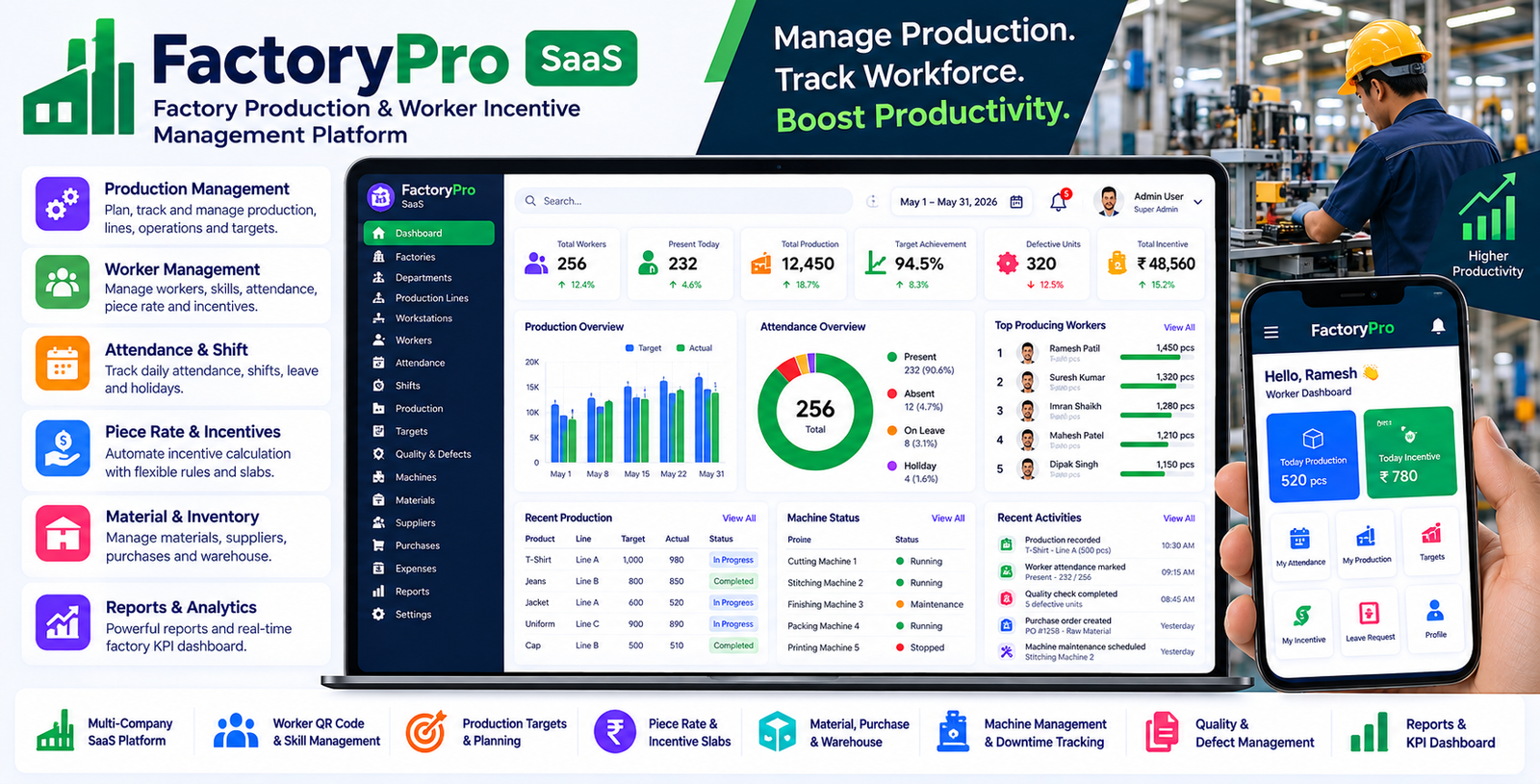
Looking for a ready-made solution?
👉Factory Production and Worker Incentive Management SaaS with Attendance and Piece Rate Tracking
https://smartwebinfotech.com/items/factory-production-and-worker-incentive-management-saas-with-attendance-and-piece-rate-tracking/1049
Managing a factory is not only about producing goods. Factory owners and production managers must coordinate workers, departments, production lines, workstations, shifts, attendance, production targets, quality, machines, materials, incentives, wages, suppliers, warehouses, and expenses.
When these processes are managed using spreadsheets, paper registers, or disconnected systems, it can become difficult to understand real-time production performance and calculate worker earnings accurately.
A Factory Production and Worker Incentive Management SaaS with Attendance and Piece Rate Tracking brings these workflows into one centralized platform.
Factory Production & Worker Incentive Management SaaS is designed to help factories manage production, workers, attendance, piece-rate wages, incentives, shifts, defects, quality control, machine downtime, materials, and productivity from one system.
What Is Factory Production Management Software?
Factory Production Management Software is a centralized digital system used to organize and monitor manufacturing operations.
Instead of maintaining separate records for production, workers, attendance, machines, materials, and incentives, a factory can connect these activities in one workflow.
A typical process can be:
Factory → Department → Production Line → Workstation → Worker → Shift → Production → Quality → Incentive → Payroll
This provides management with a more structured way to monitor factory operations.
What Is Piece-Rate Worker Management?
Piece-rate management is a compensation approach where worker earnings are associated with the quantity of completed production or defined work units rather than relying only on fixed working hours.
For example:
Worker A
Production = 500 pieces
Rate = ₹2 per piece
Piece Earnings = 500 × ₹2 = ₹1,000
In real factory operations, the calculation can be more complex because businesses may use:
- Different products
- Different operations
- Different rates
- Incentive slabs
- Quality rules
- Attendance conditions
- Production targets
- Overtime
- Deductions
Software can help standardize these calculations according to the factory's configured rules.
Why Do Factories Need Production & Worker Incentive Software?
Factories often deal with large amounts of operational data every day.
Common challenges include:
- Manual attendance registers
- Spreadsheet-based production records
- Difficult worker tracking
- Complex piece-rate calculations
- Manual incentive calculations
- Production target monitoring
- Quality and defect tracking
- Machine downtime records
- Material tracking
- Warehouse management
- Payroll calculation
- Multiple shifts
- Department-level reporting
- Difficult productivity analysis
A centralized factory management system can connect these processes and reduce repetitive manual work.
Factory Production SaaS Workflow
A modern factory workflow can be organized as:
Company
↓
Factory / Branch
↓
Department
↓
Production Line
↓
Workstation
↓
Worker
↓
Shift Assignment
↓
Attendance
↓
Production
↓
Quality / Defects
↓
Piece-Rate Calculation
↓
Worker Incentive
↓
Salary / Payroll
This creates a connected production and workforce management process.
Key Features of Factory Production & Worker Incentive SaaS
1. SaaS & Company Management
The platform supports a SaaS model with multi-company architecture. This allows the software provider to offer the factory management solution to multiple companies.
This is useful for businesses that want to build a recurring-revenue software platform for manufacturing companies.
A typical SaaS structure can be:
SaaS Owner → Company → Factory → Departments → Workers → Production
2. Multi-Company Architecture
Different factory companies can use the same application while maintaining their own operational data and configuration.
Each company can manage its own:
- Factories
- Departments
- Production Lines
- Workstations
- Workers
- Products
- Shifts
- Attendance
- Production
- Incentives
- Materials
- Suppliers
- Expenses
- Reports
This makes the platform suitable for a multi-company SaaS business model.
3. Authentication & Security
Factory systems contain important operational information.
The platform includes authentication and security functionality to help control access to the application.
Businesses should additionally configure appropriate security policies for their own environment, including strong passwords, access controls, backups, and secure hosting.
4. User & Role Management
Different employees need different levels of access.
For example:
Factory Owner
Business-wide access.
Factory Manager
Factory operations and reports.
Production Manager
Production planning and monitoring.
Supervisor
Worker and production activities.
HR / Payroll
Attendance, salary, and incentive information.
Worker
Authorized personal information and production-related access.
Role-based access helps ensure users only access functions relevant to their responsibilities.
5. Factory & Branch Management
Organizations operating multiple factories or branches can organize their operations through factory/branch management.
For example:
Company
→ Factory A
→ Factory B
→ Factory C
Each location can then have its own departments, production lines, workers, and operational information.
The product includes Factory / Branch Management.
6. Department Management
Manufacturing organizations often divide operations into departments.
Examples include:
- Cutting
- Stitching
- Assembly
- Finishing
- Packaging
- Quality Control
- Maintenance
- Warehouse
The platform includes Department Management to organize factory operations.
7. Production Line Management
Production lines are central to manufacturing operations.
A production line can be connected with:
- Factory
- Department
- Product
- Operations
- Workstations
- Workers
- Production Targets
The system includes Production Line Management.
8. Workstation Management
Different manufacturing operations may happen at different workstations.
For example:
Production Line
→ Cutting Station
→ Assembly Station
→ Finishing Station
→ Quality Station
→ Packing Station
Workstation Management helps organize these operational points within the factory.
9. Worker Management
Worker information is one of the most important parts of a production and incentive system.
A worker profile can contain information such as:
- Worker Name
- Employee/Worker Code
- Department
- Production Line
- Workstation
- Skills
- Shift
- Attendance
- Production
- Incentive
- Salary
The product includes Worker Management.
10. Worker QR Code
The system includes Worker QR Code functionality.
QR codes can provide a convenient mechanism for identifying workers within factory workflows.
Depending on the implementation, QR-based identification can potentially be used for:
- Worker identification
- Attendance workflows
- Production assignment
- Worker profile access
The exact operational process can be configured according to the factory's requirements.
11. Worker Skill Management
Different workers may have different skills and production capabilities.
For example:
Worker A
- Cutting
- Pattern Handling
Worker B
- Stitching
- Finishing
Worker C
- Quality Inspection
Worker Skill Management helps maintain this information and can support better workforce organization.
12. Shift Management
Factories frequently operate multiple shifts.
Examples:
Morning Shift
8:00 AM – 4:00 PM
Evening Shift
4:00 PM – 12:00 AM
Night Shift
12:00 AM – 8:00 AM
The system includes Shift Management for organizing factory work schedules.
13. Shift Assignment
Simply creating shifts is not enough.
Workers need to be assigned to appropriate shifts.
A shift assignment workflow can be:
Worker → Department → Production Line → Shift
The product includes Shift Assignment functionality.
14. Attendance Management
Attendance is directly connected with workforce and payroll management.
The system includes Attendance Management and an Attendance Dashboard.
Attendance records can help management understand:
- Present Workers
- Absent Workers
- Working Days
- Shift Attendance
- Leave
- Attendance Trends
15. Attendance Dashboard
A centralized dashboard can provide management with a quick overview of worker attendance.
For example:
Total Workers: 250
Present: 232
Absent: 12
On Leave: 6
Such information can help factory managers identify workforce availability.
16. Leave Management
Workers may require leave for different reasons.
The platform includes Leave Management.
Leave records can be associated with worker attendance and workforce planning.
17. Holiday Management
Factories often maintain an annual holiday calendar.
The platform includes Holiday Management for organizing non-working days.
This can help prevent confusion when calculating attendance and working days.
18. Production Management
Production Management is the core of the system.
The platform can help factories manage:
- Production
- Production Targets
- Production Planning
- Products
- Operations
- Workers
- Quality
- Production Performance
These features are included in the current product.
19. Production Target Management
Factories often establish daily, weekly, or monthly production targets.
For example:
Daily Target = 10,000 pieces
Actual production:
9,200 pieces
Achievement:
92%
Target tracking helps managers understand production performance.
20. Production Planning
Production planning helps factories determine what needs to be produced and how resources should be organized.
A planning workflow can consider:
- Product
- Quantity
- Production Line
- Operations
- Workers
- Workstations
- Target
- Schedule
The product includes Production Planning.
21. Product Management
Manufacturing companies may produce many products and variants.
Product Management can organize:
- Product Name
- Product Category
- Production Operations
- Piece Rate
- Production Targets
- Material Requirements
The system includes Product Management and Product Categories.
22. Product Category Management
Products can be grouped into categories for easier management.
For example:
Garments
- Shirt
- T-Shirt
- Trouser
Furniture
- Chair
- Table
- Cabinet
Electrical
- Switch
- Socket
- Panel
Product categories make reporting and organization easier.
23. Operation / Process Management
Many products require multiple manufacturing operations.
For example:
T-Shirt
→ Cutting
→ Stitching
→ Buttoning
→ Finishing
→ Quality Check
→ Packing
The platform includes Operation / Process Management.
24. Piece-Rate Management
Piece-rate production is particularly useful when workers are paid based on completed units or operations.
For example:
Operation
Rate
Cutting
₹1.50
Stitching
₹3.00
Finishing
₹1.25
Packing
₹0.75
A worker's production can then be associated with the applicable rate.
25. Incentive Rules
Not every factory uses a single fixed incentive calculation.
Businesses may have different incentive policies.
For example:
Below 500 pieces: No incentive
500–700 pieces: ₹0.50 extra per piece
701–900 pieces: ₹0.75 extra per piece
Above 900 pieces: ₹1 extra per piece
The platform includes Incentive Rules.
26. Incentive Slabs
Incentive Slabs allow businesses to define different levels of worker incentives.
Example:
Production
Incentive
0–500
₹0
501–700
₹250
701–900
₹500
901+
₹1,000
Actual calculations depend on the factory's configured rules.
The system includes Incentive Slabs.
27. Automatic Worker Incentive Calculation
Manual incentive calculations can become complicated when hundreds of workers and multiple production operations are involved.
The platform includes Worker Incentive Calculation.
A simplified calculation could be:
Production × Piece Rate = Piece Earnings
Then:
Piece Earnings + Incentive − Applicable Adjustments = Worker Earnings
The actual calculation should follow the factory's configured payroll and incentive rules.
28. Worker Salary Calculation
The platform also includes Worker Salary Calculation.
This can connect workforce information such as:
- Attendance
- Production
- Piece Rate
- Incentives
- Salary
into a structured salary workflow.
29. Payroll Integration
Payroll information can be connected with production and workforce data.
The product includes Payroll Integration.
This can help factories reduce duplicate data entry between production and payroll processes.
30. Quality Control
Production quantity alone does not determine factory performance.
Quality is equally important.
For example:
Produced: 10,000 pieces
Accepted: 9,700
Rejected: 300
The system includes Quality Control functionality.
31. Defect Management
Manufacturing defects can affect:
- Product Quality
- Production Cost
- Worker Performance
- Customer Satisfaction
- Delivery Time
The platform includes Defect Management.
Factories can use defect records to identify recurring problems and investigate their causes.
32. Production Quality Workflow
A simple workflow can be:
Production
↓
Quality Inspection
↓
Accepted
or
Rejected / Defective
↓
Defect Record
↓
Corrective Action
This creates a more structured quality-control process.
33. Machine Management
Machines are critical production assets.
The system includes Machine Management.
Machine records can help organize:
- Machine Name
- Machine Type
- Factory
- Department
- Production Line
- Status
- Maintenance Information
34. Machine Downtime Tracking
Machine downtime can reduce production capacity.
For example:
Planned Production: 10 hours
Machine Downtime: 2 hours
Available Production Time: 8 hours
The platform includes Machine Downtime tracking.
This can help management understand production interruptions.
35. Production Material Management
Materials are another major part of manufacturing.
Examples include:
- Raw Materials
- Components
- Packaging
- Consumables
The system includes Production Material Management.
36. Warehouse & Store Management
Factories need to know what materials are available.
The platform includes Warehouse / Store functionality.
A typical material workflow can be:
Supplier → Purchase → Warehouse → Production → Finished Goods
37. Supplier Management
Factories often work with multiple suppliers.
Supplier Management helps organize supplier information and purchasing relationships.
The product includes Supplier Management.
38. Purchase Management
Production depends on timely procurement.
Purchase Management can help factories manage purchasing activities related to production materials and supplies.
The platform includes Purchase Management.
39. Expense Management
Factories have many operating expenses.
Examples include:
- Electricity
- Maintenance
- Transport
- Materials
- Equipment
- Labor
- Administrative Expenses
The system includes Expense Management.
40. Supervisor Management
Supervisors play an important role in production environments.
They may monitor:
- Workers
- Production
- Attendance
- Quality
- Targets
- Workstations
The platform includes Supervisor Management.
41. Production Analytics
Production data becomes more useful when converted into analytics.
Management can analyze areas such as:
- Production Volume
- Worker Productivity
- Target Achievement
- Defects
- Downtime
- Incentives
- Attendance
The product includes Production Analytics.
42. Factory KPI Dashboard
A factory manager needs a quick view of operational performance.
A KPI dashboard can present information such as:
Production
Total units produced.
Target Achievement
Actual vs. planned production.
Worker Productivity
Production per worker.
Quality
Accepted vs. rejected production.
Downtime
Machine downtime.
Attendance
Worker availability.
Incentives
Worker incentive totals.
The platform includes a Factory KPI Dashboard.
43. Alerts & Notifications
Important factory events may require notifications.
Examples include:
- Low production
- Machine downtime
- Attendance issues
- Production target updates
- Operational alerts
The platform includes Alerts & Notifications and Notification Templates.
44. Email / SMTP
Email can be used for operational and administrative notifications.
The platform includes Email / SMTP functionality.
45. WhatsApp Settings
WhatsApp can be useful for operational communication.
The product includes WhatsApp Settings as part of its communication capabilities.
The actual WhatsApp workflow depends on the configured service and business requirements.
46. Reports
Factory management requires detailed reporting.
Reports can help management analyze:
- Attendance
- Production
- Workers
- Incentives
- Quality
- Defects
- Machines
- Downtime
- Materials
- Expenses
The platform includes reporting functionality.
47. Document Management
Factories generate many documents.
Examples include:
- Worker Documents
- Supplier Documents
- Production Documents
- Purchase Documents
- Operational Records
The platform includes Document Management.
48. Audit Log
Operational systems benefit from tracking important activities.
An audit log can help administrators understand changes made within the application.
The product includes Audit Log functionality.
49. Multi-Language Support
Factories may operate with workers and managers from different language backgrounds.
The platform includes Multi-Language functionality.
This can make the system more adaptable to different markets.
50. Multi-Theme Support
The platform includes Multi-Theme functionality.
Businesses can therefore have greater flexibility when configuring the software's visual presentation.
51. SaaS Subscription & Billing
The system includes Subscription / SaaS Billing functionality.
This allows the product to be positioned not only as internal factory software but also as a commercial SaaS platform.
A SaaS provider could offer:
Starter Plan
For small factories.
Professional Plan
For growing manufacturing companies.
Enterprise Plan
For larger organizations with multiple factories and advanced requirements.
Factory Worker Incentive Management Example
Consider a factory worker producing a specific operation.
Production
800 pieces
Piece Rate
₹2 per piece
Basic Piece Earnings
800 × ₹2 = ₹1,600
Suppose the configured incentive rule provides:
₹300 incentive
Then:
Total Production Earnings = ₹1,600 + ₹300 = ₹1,900
If the factory also uses attendance, salary, overtime, deductions, or other payroll rules, the final amount can be calculated according to those configured policies.
This illustrates why automated incentive calculation can be useful when worker production volumes become large.
Why Piece-Rate Tracking Matters
Piece-rate tracking provides a direct connection between production output and worker earnings.
It can help answer:
- How much did each worker produce?
- Which operation did they perform?
- What rate applies?
- How much did they earn?
- Did they achieve the target?
- What incentive did they receive?
- What was their attendance?
- What was their quality performance?
Instead of calculating these values manually, a centralized system can maintain the associated records.
Production + Attendance + Incentive Connection
One of the most useful aspects of this type of system is connecting multiple operational records.
For example:
Worker
↓
Attendance
↓
Shift
↓
Production
↓
Quality
↓
Piece Rate
↓
Incentive
↓
Salary
This provides a more complete picture of worker performance.
Factory Production Dashboard Example
A management dashboard can present:
KPI
Example
Total Workers
250
Present Today
232
Production Target
10,000
Actual Production
9,450
Target Achievement
94.5%
Defective Units
180
Machine Downtime
3.2 hrs
Incentive Amount
₹48,500
The exact metrics and calculations depend on the factory's configured processes.
Benefits of Factory Production Management Software
Centralized Factory Management
Production, workforce, materials, machines, and operational records can be managed from one platform.
Better Worker Visibility
Managers can connect worker attendance, production, skills, incentives, and salary information.
Faster Incentive Calculation
Automated rules can reduce repetitive manual calculations.
Better Production Monitoring
Production targets and actual output can be tracked systematically.
Improved Quality Tracking
Defects and quality-control records can be maintained alongside production.
Better Machine Visibility
Downtime information can help identify production interruptions.
Better Material Management
Production material and warehouse records can be organized centrally.
Improved Reporting
Management can analyze factory KPIs and production performance.
Better Payroll Coordination
Production-related earnings can be connected with worker salary calculations.
SaaS Opportunity
The software can be offered to multiple manufacturing companies through subscription-based plans.
Who Can Use Factory Production & Incentive Software?
This type of software can be useful for:
- Manufacturing Companies
- Garment Factories
- Textile Factories
- Furniture Manufacturers
- Electronics Manufacturers
- Plastic Manufacturing Units
- Packaging Companies
- Footwear Manufacturers
- Engineering Workshops
- Auto Parts Manufacturers
- Electrical Product Manufacturers
- Consumer Product Factories
- Small Manufacturing Units
- Medium Manufacturing Companies
- Large Factory Groups
The exact workflow should be configured according to the manufacturing process used by each organization.
Factory Management for Garment Manufacturing
Garment factories are a particularly useful example of piece-rate production.
A workflow could be:
Fabric
↓
Cutting
↓
Stitching
↓
Finishing
↓
Quality
↓
Packing
Different workers can be assigned to different operations, with production quantities and rates tracked at the operation level.
Factory Management for Furniture Manufacturing
Furniture production can involve:
Cutting → Assembly → Sanding → Painting → Finishing → Quality → Packing
Different workers may perform different operations.
Production and incentive tracking can therefore be organized around the specific process.
Factory Management for Electronics
An electronics manufacturing workflow might include:
Component Preparation → Assembly → Soldering → Testing → Quality → Packaging
Worker skills, workstation assignments, production quantities, and quality records can be connected to these operations.
Factory Management for Packaging
Packaging factories may produce large quantities of standardized products.
Piece-rate tracking can be particularly useful when production is measured in:
- Pieces
- Boxes
- Packs
- Units
- Bundles
Factory Software vs. Manual Management
Manual Factory Management
Factory Production SaaS
Paper attendance
Digital attendance
Excel worker records
Worker management
Manual shift allocation
Shift management
Manual production registers
Production management
Manual targets
Production targets
Manual incentive calculation
Incentive rules & slabs
Separate payroll calculations
Worker salary calculation
Paper quality records
Quality control
Manual defect records
Defect management
Machine register
Machine management
Manual downtime records
Downtime tracking
Stock spreadsheets
Warehouse / Store
Separate supplier files
Supplier management
Manual purchase records
Purchase management
Separate expense sheets
Expense management
Manual reporting
Production analytics
Static reports
KPI dashboard
Manual notifications
Alerts & notifications
Multiple disconnected systems
Centralized platform
How to Choose Factory Production Software
Before selecting a factory management solution, businesses should evaluate:
- Company Management
- Multi-Company Architecture
- Factory / Branch Management
- Department Management
- Production Lines
- Workstations
- Worker Management
- Worker QR Code
- Worker Skills
- Shift Management
- Shift Assignment
- Attendance
- Leave Management
- Holidays
- Production Management
- Production Targets
- Production Planning
- Product Management
- Product Categories
- Operations / Processes
- Piece Rates
- Incentive Rules
- Incentive Slabs
- Worker Incentive Calculation
- Defect Management
- Quality Control
- Machine Management
- Machine Downtime
- Production Materials
- Warehouse / Store
- Supplier Management
- Purchase Management
- Expense Management
- Payroll Integration
- Worker Salary Calculation
- Supervisor Management
- Production Analytics
- Factory KPI Dashboard
- Alerts
- Notifications
- Email / SMTP
- Reports
- Documents
- Audit Logs
- Multi-Language
- Multi-Theme
- SaaS Billing
Why Choose Factory Production & Worker Incentive Management SaaS?
The product combines factory production and workforce management into a single system.
Its listed feature set covers:
- SaaS / Company Management
- Multi-Company Architecture
- Authentication & Security
- User & Role Management
- Factory / Branch Management
- Department Management
- Production Line Management
- Workstation Management
- Worker Management
- Worker QR Code
- Worker Skill Management
- Shift Management
- Shift Assignment
- Attendance Management
- Attendance Dashboard
- Leave Management
- Holiday Management
- Production Management
- Production Targets
- Production Planning
- Product Management
- Product Categories
- Operation / Process Management
- Incentive Rules
- Incentive Slabs
- Worker Incentive Calculation
- Defect Management
- Quality Control
- Machine Management
- Machine Downtime
- Production Material Management
- Warehouse / Store
- Supplier Management
- Purchase Management
- Expense Management
- Payroll Integration
- Worker Salary Calculation
- Supervisor Management
- Production Analytics
- Factory KPI Dashboard
- Alerts & Notifications
- Notification Templates
- Email / SMTP
- WhatsApp Settings
- Reports
- Document Management
- Audit Log
- Multi-Language
- Multi-Theme
- Settings
- Subscription / SaaS Billing
These features are listed on the current product page.
View Factory Production & Worker Incentive Management SaaS
A Modern Factory Management Workflow
A traditional factory workflow may look like:
Paper Attendance + Excel Production + Manual Incentive + Separate Payroll + Manual Stock + Paper Quality Reports
A centralized system can transform this into:
Factory → Department → Production Line → Worker → Shift → Attendance → Production → Quality → Incentive → Salary
Procurement can connect as:
Supplier → Purchase → Warehouse → Material → Production
Machine management can connect as:
Machine → Production Line → Operation → Downtime → Production Impact
Management reporting can then bring these records together:
Production + Attendance + Quality + Machines + Materials + Incentives → Factory KPI Dashboard
The Importance of Real-Time Factory Data
Manufacturing decisions depend on accurate information.
Management may need to know:
How much was produced today?
Which line is below target?
Which workers are absent?
Which machine is down?
How many defective units were produced?
How much incentive has been generated?
How much material is available?
What are the current factory expenses?
A centralized production system makes these questions easier to answer from structured records.
Using Production Data for Continuous Improvement
Factory software should not only record production.
It can also help management identify patterns.
For example:
Low Production
→ Check attendance
→ Check machine downtime
→ Check material availability
→ Check worker productivity
→ Check defects
→ Identify bottleneck
This can support continuous improvement initiatives.
Using Incentive Data to Understand Productivity
Incentive information can provide another perspective on workforce performance.
Management can compare:
Worker Production
vs.
Target
vs.
Quality
vs.
Incentive
This can help factories understand how their configured incentive structure relates to production performance.
Incentive policies should, of course, comply with applicable employment and wage regulations.
Frequently Asked Questions
What is factory production management software?
It is software designed to manage factory operations such as production planning, workers, shifts, attendance, production targets, quality, machines, materials, and reporting.
What is piece-rate tracking?
Piece-rate tracking records production quantities and associates them with configured rates so that piece-based earnings can be calculated.
Can I manage factory workers?
Yes. Worker Management is included, along with worker QR codes and skill management.
Can I manage worker attendance?
Yes. The system includes Attendance Management, an Attendance Dashboard, Leave Management, and Holiday Management.
Can I manage multiple shifts?
Yes. Shift Management and Shift Assignment are included.
Can I manage production targets?
Yes. Production Targets and Production Planning are included.
Can I track piece-rate wages?
Yes. The product specifically includes incentive rules, incentive slabs, worker incentive calculation, and worker salary calculation.
Can I manage production quality?
Yes. The platform includes Quality Control and Defect Management.
Can I track machine downtime?
Yes. Machine Management and Machine Downtime tracking are included.
Can I manage factory materials?
Yes. Production Material Management and Warehouse / Store functionality are included.
Can I manage suppliers and purchases?
Yes. Supplier Management and Purchase Management are included.
Can I integrate production with payroll?
The platform includes Payroll Integration and Worker Salary Calculation.
Can I manage factory supervisors?
Yes. Supervisor Management is included.
Does the system provide factory analytics?
Yes. The product includes Production Analytics and a Factory KPI Dashboard.
Does it support notifications?
Yes. Alerts & Notifications, Notification Templates, Email/SMTP, and WhatsApp Settings are listed among the features.
Can this software be sold as SaaS?
Yes. SaaS/company management, multi-company architecture, and subscription/SaaS billing are included.
Can different factories use the same platform?
The product is designed with multi-company architecture, making it suitable for a SaaS model serving multiple companies.
Does it support multiple languages?
Yes. Multi-Language support is included.
Does it have audit logs?
Yes. Audit Log functionality is included.
Final Thoughts
Factory management involves much more than simply recording production quantities. Businesses need to coordinate workers, attendance, shifts, production lines, workstations, production targets, piece rates, incentives, quality, defects, machines, downtime, materials, suppliers, purchases, expenses, and payroll.
Managing all of these activities manually can create unnecessary administrative work and make it harder for management to understand factory performance.
A centralized Factory Production and Worker Incentive Management SaaS connects these processes:
Factory → Department → Production Line → Worker → Shift → Attendance → Production → Quality → Incentive → Salary
At the same time, supporting processes can connect:
Materials → Warehouse → Production
Machine → Downtime → Production
Supplier → Purchase → Material
Production → Analytics → Factory KPI Dashboard
This provides a structured digital foundation for factories looking to improve operational visibility and manage production and workforce information in one place.
Explore the Factory Production & Worker Incentive Management SaaS
The current Smartweb Infotech listing identifies the product as version 1.0 and provides regular and extended licensing options, documentation, future updates, and support.
Comments (0)