
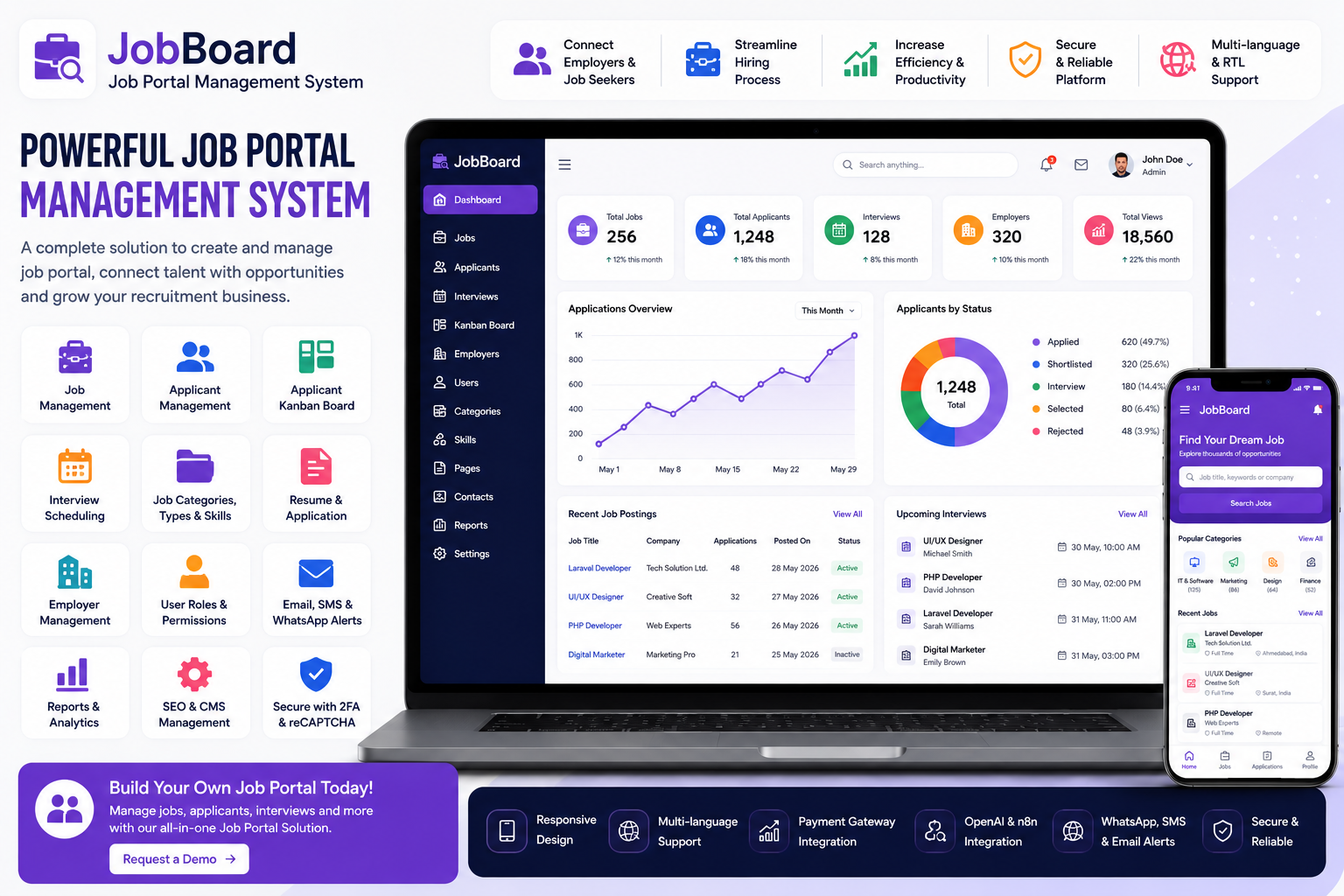
Looking for a ready-made solution?
👉 Job Portal Management System
https://smartwebinfotech.com/items/job-board-job-portal-management-system/1004
Recruitment has changed significantly in recent years. Job seekers expect to find vacancies online, submit applications quickly, and track their opportunities digitally. At the same time, employers and recruiters need efficient tools to publish jobs, manage applicants, schedule interviews, and identify the right candidates.
A Job Portal Management System provides a centralized platform where employers can publish vacancies and job seekers can search and apply for opportunities.
For entrepreneurs, recruitment agencies, and businesses looking to launch their own job marketplace, ready-to-use job portal software can significantly reduce development time and cost.
In this guide, we'll explore what a Job Portal Management System is, its key features, benefits, and how you can use it to build a modern recruitment platform.
What is a Job Portal Management System?
A Job Portal Management System is software that connects employers, recruiters, and job seekers through an online platform.
Employers can publish job vacancies, manage applications, schedule interviews, and track candidates, while job seekers can search for relevant jobs and submit applications.
A typical job portal workflow looks like:
Employer → Create Job → Publish Vacancy → Receive Applications → Review Candidates → Schedule Interview → Hire Candidate
A centralized system makes this recruitment workflow easier to manage.
Who Can Use Job Portal Software?
A Job Portal Management System can be useful for:
- Recruitment Agencies
- HR Consultants
- Staffing Companies
- Job Boards
- Employment Agencies
- Corporate HR Departments
- Local Job Portals
- Industry-Specific Recruitment Platforms
- Freelance & Hiring Platforms
- Entrepreneurs Launching Recruitment SaaS
Businesses can customize the platform according to their target industry and recruitment workflow.
Why Build a Job Portal in 2026?
The traditional recruitment process often involves multiple channels such as emails, spreadsheets, social media, and messaging applications.
This can make candidate management difficult.
A dedicated job portal can help businesses:
- Centralize job listings
- Reach more candidates
- Organize applications
- Track candidate progress
- Schedule interviews
- Improve communication
- Reduce administrative work
- Build a searchable recruitment marketplace
For entrepreneurs, a job portal can also become a digital marketplace connecting employers with job seekers.
Key Features of a Job Portal Management System
1. Informative Dashboard
A centralized dashboard gives administrators an overview of recruitment activity.
Depending on the system, administrators can monitor jobs, applicants, users, and other important activities from one place.
This provides better visibility into the overall recruitment process.
2. Job Management
Job management is one of the most important features of a recruitment platform.
Administrators or authorized employers can manage:
- Job Titles
- Job Descriptions
- Job Categories
- Job Types
- Required Skills
- Job Status
- Published Jobs
Organized job management makes it easier for candidates to find relevant opportunities.
3. Job Categories
Job categories allow vacancies to be organized into specific industries or professions.
Examples include:
- Information Technology
- Finance
- Marketing
- Healthcare
- Engineering
- Sales
- Customer Service
- Human Resources
A well-organized category structure improves the job-search experience.
4. Job Types
Different businesses offer different employment arrangements.
A job portal can categorize opportunities such as:
- Full-Time
- Part-Time
- Contract
- Temporary
- Internship
- Remote Jobs
Job types help candidates filter opportunities based on their requirements.
5. Job Skills
Skills help employers identify candidates with relevant qualifications.
A job listing can specify the skills required for a particular position.
For example:
- PHP
- Laravel
- JavaScript
- React
- Accounting
- Digital Marketing
- Sales
- Project Management
Skill-based organization can make candidate matching more efficient.
6. Applicant Management
Managing applicants is a major part of the recruitment process.
The system allows recruiters to organize candidates associated with job vacancies.
Recruiters can review applications and move candidates through different stages of the hiring process.
This reduces the need to maintain separate spreadsheets for every job opening.
7. Applicant Kanban Board
A Kanban board provides a visual way to manage candidates.
Recruiters can move applicants through different recruitment stages, such as:
Applied → Shortlisted → Interview → Selected → Rejected
This makes it easier for hiring teams to understand the current status of every candidate.
The Job Board system includes applicant management through a Kanban board.
8. Interview Scheduling
Interview scheduling is another important recruitment workflow.
Recruiters can organize interviews for shortlisted candidates and maintain better visibility over upcoming interviews.
A digital interview process can reduce scheduling confusion and improve communication between recruiters and candidates.
9. Employer & Recruiter Management
A job portal needs tools for managing the organizations and users responsible for publishing vacancies.
Role-based access allows administrators to control what different users can access.
For example:
- Owner
- Administrator
- HR Manager
- Recruiter
- Employer
The platform includes user roles and permissions for managing access.
10. Contact Management
Recruitment businesses communicate with many employers and candidates.
Contact management provides a centralized place to maintain relevant contact information and communication records.
This can help recruiters maintain better relationships with employers and candidates.
11. Job Search & Job Pages
A successful job portal needs a user-friendly job browsing experience.
Candidates should be able to discover job opportunities based on relevant information such as:
- Job Category
- Job Type
- Skills
- Location
- Job Title
Dedicated job pages can provide complete information about each vacancy and guide candidates toward the application process.
12. Support System
A recruitment platform may receive questions from employers, recruiters, and candidates.
An integrated support system can help administrators manage support requests and provide assistance from within the platform.
This can improve the overall user experience.
13. Email Notifications
Recruitment involves many events that require communication.
Email notifications can be used for:
- New Applications
- Interview Updates
- Application Status
- Account Notifications
- Recruitment Updates
Customizable email notification templates can help businesses maintain consistent communication.
14. SMS & WhatsApp Notifications
Modern recruitment platforms can use multiple communication channels.
The Job Board system includes SMS notification templates, Twilio integration, and WhatsApp integration for sending notifications.
These channels can be useful for important recruitment updates and reminders.
15. SEO Settings
SEO is particularly important for a public job portal because search engines can help bring job seekers to your website.
The system includes site SEO settings that can help administrators manage important SEO-related configurations.
A well-optimized job portal can potentially attract organic traffic from searches for job titles, skills, industries, and locations.
16. Dynamic Landing Page CMS
A professional job portal needs more than job listings.
A dynamic landing page CMS allows administrators to manage website content and create a more professional public-facing platform.
This can be useful for displaying:
- Featured Jobs
- Categories
- Platform Information
- Employer Information
- Recruitment Services
- Marketing Content
The system includes a dynamic landing page CMS and the ability to enable or disable the landing page.
17. Multi-Language Support
If you plan to operate a job portal across different regions, language support can be important.
Multi-language functionality allows businesses to make their recruitment platform accessible to a broader audience.
This can be particularly useful for regional or international job marketplaces.
18. RTL & LTR Support
If your target market includes languages written from right to left, RTL support can improve usability.
The system supports both RTL and LTR themes.
19. Light & Dark Theme
Modern users expect flexible interfaces.
Theme settings allow platforms to provide different visual experiences, including light and dark modes.
The Job Board system includes theme customization options such as light/dark mode and multiple font styles.
20. Two-Factor Authentication
Recruitment platforms can contain sensitive information such as candidate profiles and employer information.
Two-factor authentication provides an additional security layer for user accounts.
The system includes 2FA functionality.
21. Google reCAPTCHA
Public recruitment websites can receive spam registrations and automated submissions.
Google reCAPTCHA can help protect forms and user interactions against automated abuse.
The system includes Google reCAPTCHA settings.
22. AI & Automation Integrations
Modern recruitment platforms can benefit from automation and artificial intelligence.
The Job Board system includes:
- OpenAI Integration
- n8n Integration
These integrations can provide opportunities for AI-assisted features and workflow automation.
For example, businesses could potentially build workflows around candidate communication, notifications, content generation, or other recruitment processes depending on their configuration.
23. Payment Gateway Integration
If you're building a commercial job portal, you may charge employers for services such as:
- Job Posting
- Featured Listings
- Recruitment Packages
- Employer Subscriptions
- Premium Services
The system includes Razorpay payment gateway integration.
This can help entrepreneurs build monetization options into their job portal.
Benefits of a Job Portal Management System
A modern job portal can provide several benefits.
For Employers
- Publish vacancies online
- Manage applicants
- Organize candidates
- Schedule interviews
- Track hiring progress
For Recruiters
- Manage multiple vacancies
- Centralize candidate information
- Use applicant Kanban workflows
- Improve recruitment organization
For Job Seekers
- Search job opportunities
- Browse categories
- Find jobs by skills and job types
- Apply through an online platform
For Job Portal Owners
- Build a recruitment marketplace
- Monetize job postings
- Manage platform users
- Customize website content
- Integrate communication tools
- Build a scalable recruitment business
How to Start Your Own Job Portal
If you want to launch a job portal business, the process can be divided into several steps.
Step 1: Choose Your Niche
Instead of targeting every type of job from day one, consider focusing on a specific market.
For example:
- IT Jobs
- Healthcare Jobs
- Engineering Jobs
- Local Jobs
- Remote Jobs
- Government Jobs
- Freelancer Jobs
A focused niche can make marketing and user acquisition easier.
Step 2: Define Your Business Model
Decide how your platform will generate revenue.
Potential models include:
- Paid Job Listings
- Featured Jobs
- Employer Subscriptions
- Recruitment Services
- Candidate Premium Accounts
- Advertising
- Employer Packages
Step 3: Launch Your Job Portal
Instead of developing a complete recruitment platform from scratch, a ready-made job portal solution can significantly reduce development time.
You can customize branding, content, features, integrations, and workflows according to your requirements.
Why Choose Smartweb Infotech Job Board?
If you're looking for a ready-to-use Job Portal Management System, Smartweb Infotech's Job Board provides a complete platform for managing job listings, applicants, interviews, users, and recruitment workflows.
The system is built with PHP Laravel and includes job management, applicant management, interview scheduling, applicant Kanban management, job categories, job types, skills, reports, notifications, SEO settings, CMS capabilities, and multiple integrations.
Key Features
- Informative Dashboard
- User Management
- Roles & Permissions
- Job Management
- Applicant Management
- Applicant Kanban Board
- Interview Scheduling
- Job Categories
- Job Types
- Job Skills
- Job Pages
- Contact Management
- Support System
- Reports
- SEO Settings
- Dynamic Landing Page CMS
- Multi-Language Support
- RTL/LTR Support
- Light/Dark Theme
- Google reCAPTCHA
- Email Notifications
- SMS Notifications
- Twilio Integration
- WhatsApp Notifications
- Razorpay Payment Gateway
- OpenAI Integration
- n8n Integration
- Two-Factor Authentication
The current system requirements include PHP 8.1 or higher and required PHP extensions such as BCMath, Ctype, Fileinfo, JSON, Mbstring, OpenSSL, PDO, Tokenizer, and XML.
Frequently Asked Questions
What is a Job Portal Management System?
A Job Portal Management System is software that allows businesses or entrepreneurs to create and manage an online recruitment platform where employers can publish jobs and candidates can find and apply for vacancies.
What features should a Job Portal have?
Important features include job management, applicant management, interview scheduling, job categories, job types, skills, candidate tracking, notifications, employer management, reports, and SEO tools.
Can I create my own job portal?
Yes. You can build a job portal from scratch or use a ready-made Job Portal Management System and customize it according to your business requirements.
Can employers manage applicants?
Yes. Applicant management allows recruiters and employers to review candidates and track their progress through the hiring process.
What is an applicant Kanban board?
An applicant Kanban board provides a visual workflow for moving candidates between recruitment stages such as Applied, Shortlisted, Interview, Selected, and Rejected.
Can a job portal generate revenue?
Yes. Common monetization models include paid job postings, featured listings, employer subscriptions, premium recruitment services, advertising, and other employer-focused services.
Can I customize a Job Portal Management System?
A ready-made system can generally be customized according to your branding, workflows, integrations, and business requirements. The extent of customization depends on the underlying software and development requirements.
Final Thoughts
A successful recruitment platform needs to do more than publish job vacancies. It needs to connect employers and candidates while providing recruiters with efficient tools to manage the entire hiring workflow.
A Job Portal Management System can centralize job listings, applications, interviews, candidate tracking, communication, and reporting in one platform.
For entrepreneurs, recruitment agencies, and businesses looking to launch their own online hiring platform, Job Board – Job Portal Management System provides a ready-to-use foundation that can be customized and expanded according to business requirements.
Comments (0)