
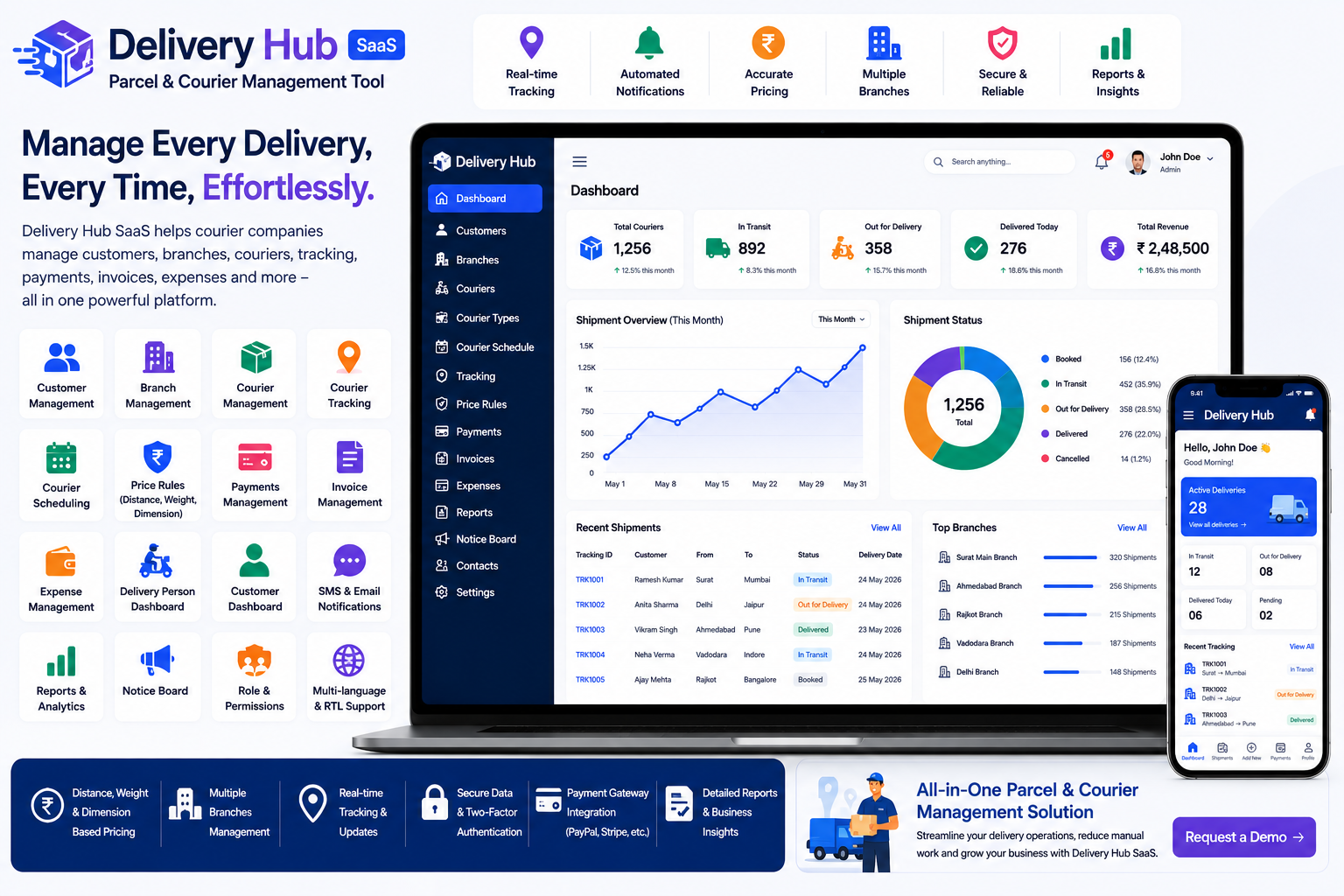
Looking for a ready-made solution?
👉 Parcel & Courier Management Tool
https://smartwebinfotech.com/items/delivery-hub-saas-parcel-courier-management-tool/1025
The courier and parcel delivery industry depends on speed, accuracy, and visibility. From receiving a parcel to dispatching it, assigning a delivery person, tracking its progress, calculating delivery charges, and completing the final delivery, every step needs to be properly coordinated.
Managing these activities manually can become difficult as the number of parcels, customers, branches, and delivery staff increases.
A Parcel & Courier Management Tool helps courier companies, delivery businesses, logistics providers, and entrepreneurs manage their delivery operations from one centralized platform.
In this guide, we'll explore what Courier Management Software is, its key features, benefits, and how Delivery Hub SaaS can help businesses digitize their parcel and courier operations.
What Is a Parcel & Courier Management Tool?
A Parcel & Courier Management Tool is software designed to help businesses manage courier operations, parcel deliveries, customers, branches, delivery personnel, payments, invoices, and tracking.
A typical courier workflow can look like:
Customer → Parcel Booking → Price Calculation → Courier Dispatch → Delivery Assignment → Tracking → Delivery → Payment
Instead of managing these activities through paper records, spreadsheets, phone calls, and separate systems, businesses can manage them through a centralized platform.
Delivery Hub SaaS is a cloud-based parcel and courier management platform designed to streamline courier dispatch, delivery tracking, and courier management operations.
Why Do Courier Businesses Need Management Software?
Courier companies often handle hundreds or thousands of delivery transactions.
Manual processes can create problems such as:
- Difficult parcel tracking
- Incorrect delivery charges
- Manual courier assignment
- Poor branch coordination
- Difficult payment tracking
- Delayed invoice generation
- Unorganized customer records
- Difficulty monitoring courier status
- Limited operational reporting
A digital courier management system can centralize these activities and provide better visibility across the delivery operation.
Key Features of a Parcel & Courier Management Tool
1. Informative Dashboard
A centralized dashboard gives administrators an overview of courier operations.
Managers can use the dashboard to monitor important activities and access different modules from one place.
This can provide better visibility into:
- Customers
- Couriers
- Deliveries
- Payments
- Invoices
- Expenses
- Transactions
- Reports
2. Customer Management
Customers are an important part of any courier business.
A customer management module can maintain:
- Customer Name
- Contact Details
- Address
- Branch Information
- Courier History
- Payment Information
- Invoice History
- Tracking History
Centralized customer records make it easier for staff to retrieve information and provide better support.
3. Branch Management
Courier businesses may operate through multiple branches or locations.
Branch management allows organizations to maintain information about different operational locations.
This can be useful for:
- Local Courier Companies
- Regional Delivery Businesses
- Multi-Branch Logistics Companies
- Franchise Courier Networks
Managing branches from a centralized system can improve coordination between locations.
4. Courier Management
Courier management helps businesses maintain detailed records of parcels and courier shipments.
Organizations can manage information related to:
- Courier Details
- Customer
- Courier Type
- Courier Category
- Courier Status
- Delivery Information
- Tracking Information
Delivery Hub SaaS includes dedicated Courier & Courier Type Management.
5. Courier Schedule Management
Courier businesses need to coordinate delivery schedules efficiently.
A courier scheduling module can help manage:
- Delivery Dates
- Courier Assignments
- Delivery Schedules
- Dispatch Activities
- Delivery Status
This can help businesses organize their daily courier operations.
6. Courier Tracking Management
Tracking is one of the most important features of modern courier software.
Customers want to know where their parcel is and what stage of delivery it has reached.
A courier tracking system can help businesses maintain tracking information throughout the delivery process.
Delivery Hub SaaS includes Courier Tracking Management, and customers can also view their courier tracking history.
7. Customer Tracking History
Providing customers with access to tracking history improves transparency.
Customers can check relevant information about their courier delivery without having to contact customer support for every update.
This can reduce support requests and improve the overall customer experience.
8. Courier Stage Management
Courier operations usually involve multiple stages.
For example:
Booked → Picked Up → Dispatched → In Transit → Out for Delivery → Delivered
A courier stage management system allows businesses to define and monitor these stages.
This gives staff a clear view of where each parcel currently stands.
Delivery Hub SaaS includes Courier Stage, Category & Tag Management.
9. Courier Category & Tag Management
Different parcels may require different handling or classification.
Categories and tags can help organizations organize courier records based on their business requirements.
For example:
- Standard
- Express
- Fragile
- Priority
- International
- Commercial
Custom tags can provide additional flexibility for parcel organization.
10. Distance-Based Pricing
Delivery charges can depend on the distance between pickup and delivery locations.
A distance-based pricing system allows businesses to define pricing rules according to distance.
For example:
- 0–5 km
- 5–10 km
- 10–25 km
- 25–50 km
Delivery Hub SaaS includes Distance Price Rules Management.
11. Weight-Based Pricing
Parcel weight is another important factor in courier pricing.
A courier business can define different pricing rules based on weight ranges.
For example:
- Up to 1 kg
- 1–5 kg
- 5–10 kg
- 10–25 kg
Delivery Hub SaaS includes Weight Price Rules Management.
This can help automate delivery price calculations.
12. Dimension-Based Pricing
Some courier businesses calculate delivery charges based on package dimensions or volumetric weight.
Dimension-based pricing allows businesses to define rules according to parcel size.
This is particularly useful for larger packages where physical dimensions can affect shipping costs.
Delivery Hub SaaS includes Dimension Price Rules Management.
13. Courier Payment Management
Courier businesses need to track payments associated with delivery services.
A payment management system can help record:
- Payment Amount
- Payment Date
- Payment Method
- Customer
- Courier
- Transaction Status
Delivery Hub SaaS includes dedicated Courier Payment Management.
14. Invoice Management
Professional invoice management is essential for courier businesses.
Invoices can include:
- Customer Information
- Courier Details
- Delivery Charges
- Additional Charges
- Taxes
- Total Amount
- Payment Status
Centralized invoice management can reduce manual billing and improve financial record keeping.
15. Expense Management
Courier companies have various operating expenses.
Examples include:
- Fuel
- Vehicle Expenses
- Driver Payments
- Branch Expenses
- Packaging
- Salaries
- Office Expenses
- Other Operational Costs
An expense management module helps businesses record and monitor these costs.
Delivery Hub SaaS also includes Expense & Expense Type Management.
16. Delivery Driver Dashboard
Delivery personnel need access to information relevant to their assigned work.
A dedicated driver dashboard can provide access to assigned courier activities and delivery-related information.
Delivery Hub SaaS includes a Delivery Man/Driver Dashboard Panel.
This can improve communication between administrators and delivery staff.
17. Customer Dashboard
A customer dashboard provides customers with a self-service interface.
Customers can access relevant courier information and tracking history without depending entirely on customer support.
Delivery Hub SaaS includes a dedicated Customer Dashboard Panel.
18. SMS Notifications
Timely communication is important in courier operations.
SMS notifications can be used for:
- Courier Updates
- Delivery Status
- Tracking Information
- Customer Notifications
- Payment Updates
Delivery Hub SaaS includes SMS templates and Twilio integration for sending SMS.
19. Email Notifications
Email can also be used to communicate courier-related updates.
Businesses can configure notification templates according to their operational requirements.
This provides another communication channel for customers and internal users.
20. Notice Board
A digital notice board can help businesses communicate important announcements to users.
It can be used for:
- Operational Notices
- Delivery Announcements
- Branch Updates
- Staff Communication
- General Information
Delivery Hub SaaS includes Notice Board Management.
21. Contact Diary Management
Courier companies communicate with customers, vendors, delivery partners, and other stakeholders.
A contact diary helps maintain organized contact information in one place.
This can be useful for maintaining business relationships and operational contacts.
22. Reports & Analytics
Reports help courier companies understand their operations and financial performance.
Delivery Hub SaaS includes reports such as:
- Transaction History Report
- Income & Expense Report
- Courier Summary Report
These reports can help management understand courier activity, revenue, expenses, and overall business performance.
23. Payment Gateway Integration
If a courier company operates an online platform, customers may need to pay delivery charges digitally.
Delivery Hub SaaS supports payment configurations including:
- Bank Transfer
- PayPal
- Stripe
- Flutterwave
- Paystack
This can make online payment collection more convenient.
24. Role-Based Permissions
Different users require different access levels.
For example:
- Super Admin
- Owner
- Branch Staff
- Customer
- Delivery Driver
Role and permission management allows administrators to control access to different parts of the system.
Delivery Hub SaaS includes User Roles and Permissions.
25. Multi-Language Support
Courier businesses serving different regions may need multiple languages.
Multi-language support can make the platform more accessible to customers and staff across different markets.
Delivery Hub SaaS includes multi-language functionality.
26. RTL & LTR Support
Businesses serving markets that use right-to-left languages may require RTL support.
The system supports both RTL and LTR themes, providing flexibility for different markets.
27. SaaS Subscription Management
Entrepreneurs can also use courier management software as the foundation for a SaaS business.
Delivery Hub SaaS includes:
- Subscription Packages
- Subscription Coupons
- Coupon History
- Pricing Feature Controls
- Landing Page Controls
- Registration Page Controls
This allows entrepreneurs to offer courier management software to multiple businesses using subscription-based plans.
Benefits of Parcel & Courier Management Software
Improve Delivery Visibility
Track courier activities and provide customers with better visibility into their shipments.
Reduce Manual Work
Automate and centralize courier records, payments, invoices, and delivery information.
Improve Customer Experience
Give customers access to their courier tracking history and timely notifications.
Simplify Pricing
Use distance, weight, and dimension-based pricing rules to create more structured delivery charges.
Improve Financial Management
Track payments, invoices, income, and expenses from one platform.
Improve Branch Coordination
Manage customers and courier operations across multiple branches.
Improve Operational Reporting
Use courier, transaction, income, and expense reports to understand business performance.
Who Can Use a Parcel & Courier Management System?
A courier management platform can be useful for:
- Courier Companies
- Parcel Delivery Businesses
- Local Delivery Services
- Logistics Companies
- E-commerce Delivery Businesses
- Last-Mile Delivery Companies
- Express Delivery Services
- Multi-Branch Courier Agencies
- Shipping Businesses
- Delivery Startups
- Logistics Entrepreneurs
How to Choose the Best Courier Management Software
Before selecting a courier management solution, consider:
- Customer Management
- Branch Management
- Courier Management
- Courier Scheduling
- Courier Tracking
- Customer Tracking History
- Courier Stages
- Courier Categories
- Distance-Based Pricing
- Weight-Based Pricing
- Dimension-Based Pricing
- Payment Management
- Invoice Management
- Expense Management
- Driver Dashboard
- Customer Dashboard
- SMS Notifications
- Email Notifications
- Reports
- User Roles & Permissions
- Payment Gateways
- Multi-Language Support
- SaaS Capabilities
- Customization Options
The best solution should match your delivery workflow and be capable of supporting your business as it grows.
Why Choose Delivery Hub SaaS?
If you're looking for a ready-to-use Parcel & Courier Management Tool, Delivery Hub SaaS by Smartweb Infotech provides a centralized platform for managing customers, branches, couriers, schedules, tracking, pricing, payments, invoices, expenses, and delivery operations.
The current product includes courier and courier-type management, courier scheduling, tracking, customer tracking history, pricing rules based on distance, weight and dimensions, customer and driver dashboards, reports, notifications, payment integrations, and SaaS subscription functionality.
Key Features
- Informative Dashboard
- Customer Management
- Branch Management
- Courier Management
- Courier Type Management
- Courier Schedule Management
- Courier Payment Management
- Courier Tracking Management
- Customer Tracking History
- Invoice Management
- Expense Management
- Expense Type Management
- Contact Diary
- Notice Board
- Courier Stage Management
- Courier Category & Tag Management
- Distance Price Rules
- Weight Price Rules
- Dimension Price Rules
- Customer Dashboard
- Delivery Driver Dashboard
- Transaction Management
- Income & Expense Reports
- Courier Summary Reports
- Email Notifications
- SMS / Twilio Integration
- Payment Gateway Integration
- Multi-Language Support
- RTL/LTR Support
- SEO Settings
- Dynamic Landing Page CMS
- Google reCAPTCHA
- Two-Factor Authentication
- Light/Dark Theme
- Multi-Font Support
- SaaS Subscription Packages
- Coupon Management
- Impersonation Feature
Frequently Asked Questions
What is a Parcel & Courier Management Tool?
A Parcel & Courier Management Tool is software that helps courier and logistics businesses manage customers, parcels, courier schedules, tracking, pricing, payments, invoices, expenses, and delivery operations.
Can customers track their parcels?
Yes. Delivery Hub SaaS includes courier tracking management and allows customers to view their courier tracking history.
Can courier prices be calculated based on distance?
Yes. The platform includes distance-based pricing rules.
Can courier pricing depend on parcel weight?
Yes. Weight-based pricing rules are supported.
Can courier charges be based on package dimensions?
Yes. Delivery Hub SaaS includes dimension-based price rules.
Can I manage multiple branches?
Yes. The platform includes customer and branch management functionality, making it suitable for businesses operating across multiple locations.
Can delivery drivers access their own dashboard?
Yes. The platform includes a dedicated Delivery Man/Driver Dashboard Panel.
Can customers have their own dashboard?
Yes. Delivery Hub SaaS includes a Customer Dashboard Panel.
Can I send SMS notifications?
Yes. The system includes SMS templates and Twilio integration for sending SMS.
Can I manage courier payments and invoices?
Yes. Courier payment management and invoice management are included.
Can this software be used as a SaaS business?
Yes. Delivery Hub SaaS includes subscription packages, coupon management, pricing controls, and other SaaS functionality.
Final Thoughts
The courier and parcel delivery industry requires efficient coordination between customers, branches, delivery personnel, and management.
A modern Parcel & Courier Management Tool can help businesses organize courier bookings, schedules, tracking, pricing, payments, invoices, expenses, and customer communication from one centralized platform.
For courier companies, delivery startups, logistics businesses, and entrepreneurs looking to launch their own courier SaaS platform, Delivery Hub SaaS – Parcel & Courier Management Tool provides a ready-to-use foundation for digitizing delivery operations and building a scalable courier management business.
Comments (0)